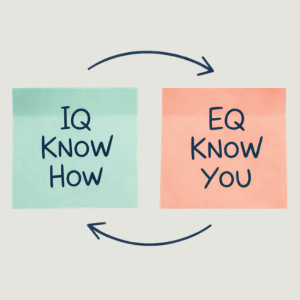
The future of effective leadership won’t be decided by who is the smartest in the room. Intelligence (IQ) only takes leaders so far. Evidence consistently links Emotional Intelligence (EQ) with stronger leadership outcomes because it shapes how leaders respond under pressure, communicate clearly, and bring people with them when things don’t go to plan.
So is the future of effective leadership Emotional Intelligence?
What is Emotional Intelligence?
Emotional Intelligence, or EQ, is the ability to understand and manage your own emotions while recognising and positively influencing the emotions of others. Leaders with high EQ use empathy, self-awareness, and strong social skills to inspire and motivate, navigate conflicts, and create an environment where both individuals and organisations can thrive.
EQ vs. IQ: Why Emotional Intelligence matters more
IQ (Intelligence Quotient) measures cognitive capability such as logical reasoning, analysis and problem-solving. It matters, but intelligence only takes leaders so far, especially in the day-to-day when change unsettles people, tension builds, or difficult conversations can’t be avoided.
Research indicates that success at work and in life depends far more on Emotional Intelligence than intellect alone, often described as an 80/20 split: about 80% to EQ and 20% attributed to IQ.
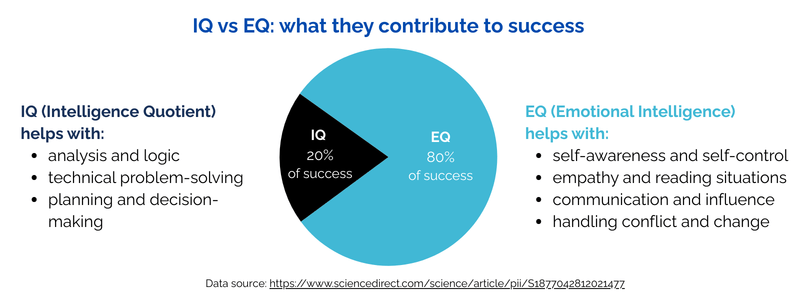
So if 80% of success in life and work is driven through EQ, then how much effort do we actually put into developing our EQ?
Strikingly, only 42% of companies offer EQ training, yet businesses that do invest in EQ are 3.2 times more effective in leadership development.
The benefits of high EQ Leaders
Improved psychosocial safety
Leaders with high EQ develop environments where employees feel valued, understood, and psychologically safe, which can support better mental health outcomes, reduce workplace stress, and build resilience. They do this by applying empathy and dealing appropriately with negative emotions in themselves and others (Cherry, 2022a).
Workplace performance and productivity
Studies link EQ with being more productive (Wong & Law, 2002). Research also suggests EQ can be a better predictor of success than IQ or technical skills (Feist & Barron, 1996).
Enhanced team collaboration and conflict resolution
High EQ helps leaders support collaboration when people disagree by listening before making decisions, showing empathy, and dealing appropriately with negative emotions. Leaders who can do this are better placed to stay constructive during conflict, address issues directly, and help the team move forward.
Greater adaptability and innovation
Emotionally intelligent leaders can adapt to change with resilience and inspire creative problem-solving, allowing leaders to harness emotions constructively, which can lead to innovative solutions and a more agile team.
Better employee retention and engagement
Employees are more likely to stay with a leader who values and understands their emotional needs. High EQ helps leaders build trust and loyalty, leading to higher retention rates and increased engagement. Studies have found emotionally intelligent individuals have greater job satisfaction and find more opportunities for advancement (Wong & Law, 2002).
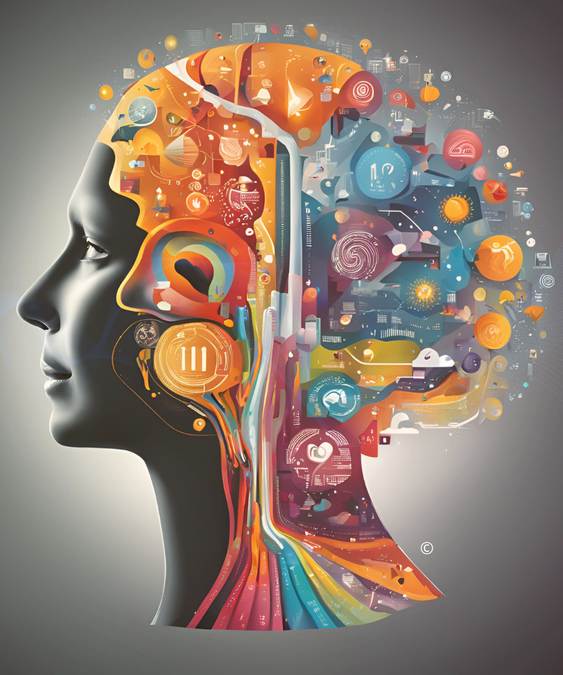
The Four Dimensions of Emotional Intelligence
The capacity to manage your emotions, particularly in stressful situations, and maintain a positive attitude.
Social awareness
The skill to understand and empathise with the emotions of others, recognising social dynamics within a group.
Relationship management
The ability to manage relationships to move people into a desired direction, effectively resolving conflicts and inspiring others.
Our EQ is not fixed. With practice and targeted development, leaders can build greater self-awareness, self-management, empathy, and relationship skills. These capabilities show up where leadership counts most: under pressure, during change, and in difficult conversations. Being the smartest in the room helps, but the future of effective leadership is EQ.
Science Direct EQ vs. IQ Which is Most Important in the Success or Failure of a Student?
Research data from Gitnux Data Research on Global Mental Health statistics.