Learn the practical workplace culture attributes that help organisations keep operating, support their industry, and step up for community when it matters.
In Australia, we pride ourselves on helping each other out in tough times. Whether it’s bushfires, floods, or fast-moving market shifts, our instinct is to jump in, lend a hand, and support the bigger picture, even if that means helping our competitors.
Under challenging conditions, why are some organisations able to maintain day-to-day operations and still step up to support their industry and the wider community?
The reason is when your internal culture is strong, your organisation can do more than just cope. It can contribute. It can support its industry. It can lend resources, knowledge, and care to its community.
Consider the thoroughbred racing industry during recent bushfires. Despite being direct competitors, trainers worked together to relocate horses, share feed, and protect the industry’s ability to recover. Inglis Horse Sales, a major business, took in hundreds of animals, resourced extra staff, and continued running operations, because their internal culture made it possible.
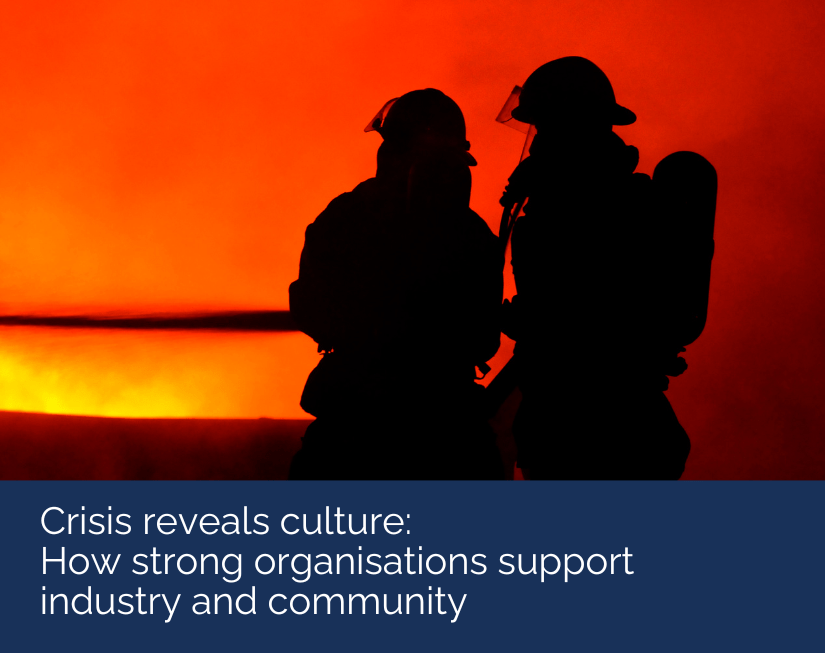
Crisis reveals culture
Culture is often invisible when everything’s running smoothly. But under pressure, it becomes obvious fast. Do people pull together or fall apart? Do they act with accountability, or look for someone to blame? Do they adapt and act, or freeze and wait?
If your organisational culture isn’t already strong, aligned, and resilient, you won’t be able to help others. You’ll be too busy putting out your own fires, literally or metaphorically.
Organisations that can maintain day-to-day operations and step up to support their community and wider industry usually have ways of working based on these of practical cultural attributes:
- Everyone is clear on what matters most
Under pressure, people make trade-offs whether leaders name them or not. Strong cultures make priorities clear. Leaders state what comes first, what can wait, and what “good” looks like right now, so teams aren’t guessing. - High trust and shared values
Trust is banked through everyday leadership behaviours: People rely on each other, understand what matters, and act consistently when normal systems and routines break down. Leaders show up consistently, not only when it is urgent. - Fast, decentralised decisions
Teams know what they can decide without waiting for senior sign-off, so they can respond quickly as conditions change. - Strong teamwork and coordination
People collaborate across roles and teams, share information early, and stay aligned on the same priorities instead of working at cross purposes. - Psychological safety and care for capacity
People can speak up early, admit mistakes, and ask for help without fear of blame or payback. Leaders actively manage workload, fatigue, and stress, set realistic expectations, and make it safe to pause, reprioritise, or escalate when risk is rising. This protects people and helps the organisation sustain effort over time. - Clear, credible communication with the community
The organisation communicates early, honestly, and clearly, which builds confidence and makes external support more effective. - Innovation under pressure
Teams are encouraged to test workable creative ideas quickly, solve problems in real time, and learn as they go rather than freezing or sticking rigidly to old processes.
In the end, the organisations that help others in a crisis usually did the work on their culture long before the crisis arrived. They clarified priorities, built trust through everyday leadership, and made it easier for people to decide, coordinate, and speak up. That’s what creates the capacity to keep operating and contribute beyond your own walls when it matters most.
 Want to build a culture that holds under pressure?
To discuss your needs, contact LDN on 03 9510 0477 or email us at info@ldn.com.au.